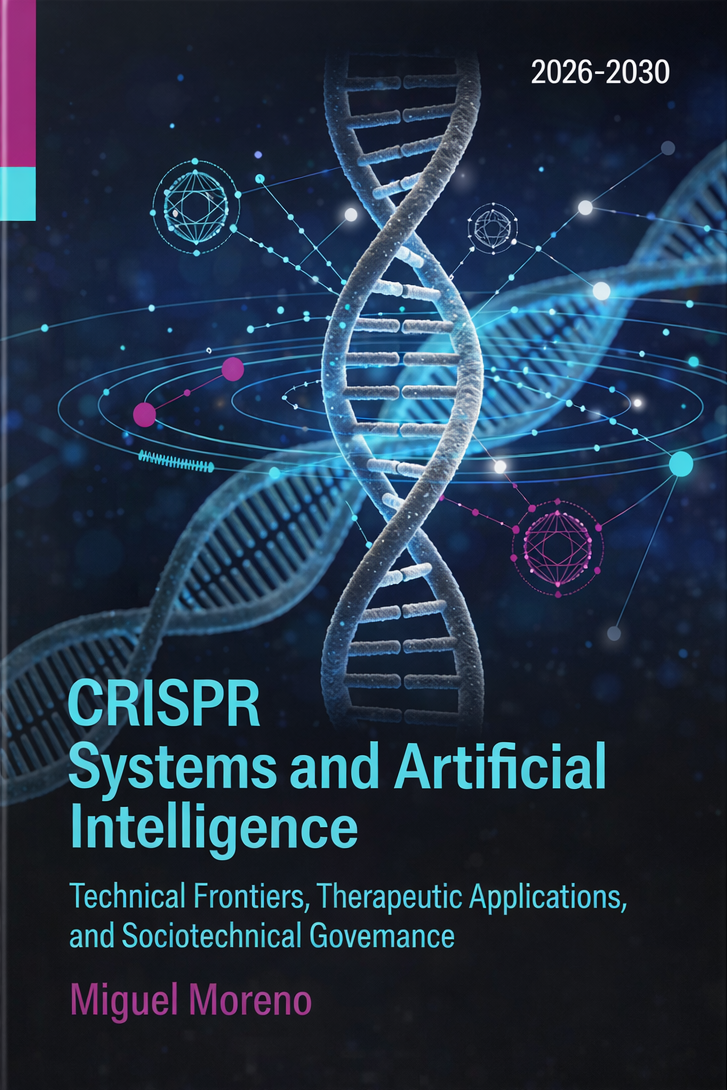
CRISPR Systems and Artificial Intelligence
Technical Frontiers, Therapeutic Applications, and Sociotechnical Governance

Preface
This monograph examines the convergence of CRISPR-based genome editing systems and artificial intelligence, tracing the trajectory from molecular mechanism to clinical application to sociotechnical governance. It is structured as an integrated analysis across three registers: the technical, the therapeutic, and the normative.
Part I provides a systematic review of CRISPR architectures (Cas9, Cas12, base editors, prime editors, epigenome editors) and the machine‑learning models and AI‑based design tools currently informing their design, optimisation, and deployment. Part II maps the therapeutic landscape — focusing on genetic rare diseases and hereditary cancer predispositions — and examines how AI is transforming each stage of the clinical pipeline, from biomarker discovery to trial design. Part III analyses the regulatory frameworks governing these technologies in Europe and internationally, develops a bioethical and Science and Technology Studies (STS) framework for evaluating their societal implications, and constructs prospective scenarios for the period 2026–2030.
Throughout, the monograph maintains an active STS lens: CRISPR-AI systems are analysed not merely as technical artefacts but as sociotechnical assemblages embedded in networks of funding, regulation, clinical practice, and public imagination. Each Part closes with a brief Sociotechnical Interlude connecting the preceding technical material to broader questions of governance, equity, and scientific legitimacy.
This work contributes to several active EU-funded research projects under Horizon Europe, including PREDI-LYNCH (liquid biopsy and Lynch syndrome surveillance), LATE-AYA (digital phenotyping in adolescent and young adult cancer survivors), and nationally funded projects on germline editing governance and human autonomy in AI-mediated clinical decisions.
Moreno-Muñoz, M. (2026). CRISPR Systems and Artificial Intelligence: Technical Frontiers, Therapeutic Applications, and Sociotechnical Governance. Universidad de Granada. https://doi.org/10.5281/zenodo.19136685
This monograph is available at:
Primary site: crispr-ai-chi.vercel.app
Mirror 1: crispr-ai.netlify.app
Mirror 2: cloudflare
Repository: github.com/utilizas/crispr-ai
Archival deposit: Zenodo (DOI: 10.5281/zenodo.19136685)
Acknowledgements
This monograph was developed within the framework of the following research projects:
- PREDI-LYNCH — Validated non-invasive liquid biopsy tests for cancer PREDIction in LYNCH Syndrome (Horizon Europe, Grant Agreement 101213916)
- LATE-AYA / PredictAYA — Prediction and prevention of late effects in AYA cancer survivors (Horizon Europe, Grant Agreement 101214879)
- GRIFOLS-2024 — Synthetic DNA and assisted reproduction: germline editing governance (Coord.: Adrián Villalba)
- GRIFOLS-2022 — Artificial gametes: normative framework (Coord.: Adrián Villalba)
- AUTAI (PID2022-137953OB-I00) — Human autonomy and artificial intelligence (Coords.: Francisco Lara, Blanca Rodríguez)
The author gratefully acknowledges the contributions of predoctoral researchers for their valuable feedback on the experimental validation of CRISPR systems reviewed in Part I. This work has benefited from the use of Claude Sonnet and Opus (Anthropic) for literature synthesis, manuscript organization, proofreading, consistency checking, and R code generation.
Abbreviations
| Abbreviation | Full term |
|---|---|
| AAV | Adeno-associated virus |
| ABE | Adenine base editor |
| AI | Artificial intelligence |
| AYA | Adolescent and young adult |
| BE | Base editor |
| Cas | CRISPR-associated protein |
| CBE | Cytosine base editor |
| CRC | Colorectal cancer |
| CRISPR | Clustered regularly interspaced short palindromic repeats |
| crRNA | CRISPR RNA |
| DL | Deep learning |
| DSB | Double-strand break |
| EC | Endometrial cancer |
| EMA | European Medicines Agency |
| FDA | Food and Drug Administration |
| gRNA | Guide RNA |
| HDR | Homology-directed repair |
| LNP | Lipid nanoparticle |
| LS | Lynch syndrome |
| ML | Machine learning |
| MMR | Mismatch repair |
| NHEJ | Non-homologous end joining |
| PAM | Protospacer adjacent motif |
| PE | Prime editor |
| pegRNA | Prime editing guide RNA |
| PROM | Patient-reported outcome measure |
| RNP | Ribonucleoprotein |
| sgRNA | Single guide RNA |
| STS | Science and Technology Studies |
| tracrRNA | Trans-activating CRISPR RNA |